

Cheap insurance has made cars a practical choice for people who want stable, long-term ownership costs. Insurance frequently has a surprisingly significant impact on a car’s total affordability, even though maintenance and fuel economy are important. Today’s drivers search out cars with stable claims records, minimal repair costs, and high safety ratings, all of which automatically lower insurance rates.
Five Toyota models and five other well-known vehicles that typically have cheaper insurance rates are included in this article. The intention is to provide you with a clear, impartial, and educational guide that enables you to make decisions with confidence.
Understanding What Makes Cheap Car Insurance
Before setting premiums, insurance companies analyze the degree of risk associated with a car. Low-risk vehicles are often those with strong safety features, high reliability, and affordable repair costs.
Insurance affordability is influenced by a number of elements, including market value, the availability of components, safety performance, and even theft rates.
The Function of Vehicle Size and Style
Little and mid-sized cars typically have lower insurance costs. This occurs because:
- They are less expensive to fix
- Their engines are of a moderate size
- Typically, they stay away from high-performance risk groups
Vehicles that are simple to operate, frequently driven, and consistently repaired are preferred by insurers.
Safety Ratings’ Effect
The likelihood of serious accidents is decreased by strong accident test results and cutting-edge safety features.
High-rated safety vehicles frequently offer advantages like:
- Reduce the impact of the claim
- Reduced payments for medical care
- Driver assistance devices have reduced crashes
Insurance providers classify them as lower-risk sectors as a result.
Impact of Materials Availability and Repair Costs
Budget-insurance category includes vehicles with readily available parts and consistent repair schedules. Insurers view the overall financial risk as significantly lower when repairs are fast and reasonably priced.
Many Toyota cars and other popular models usually have large parts networks, which lowers insurance rates.
Top 10 Cars with Cheap Insurance in 2025
When selecting a car with reasonably priced insurance in 2025 then it’s important to understand how insurers evaluate risk, repair costs, vehicle safety, and historical claims trends. Three types of cars often have reduced premiums:
- They are less expensive to fix after mishaps.
- They have fewer serious collisions.
- They perform consistently and with great efficiency.
- There is little chance of theft.
- Their engines remain within non-performance, modest levels.
Below is a detailed explanation of the top ten reasonably priced cars, with an emphasis on insurance, including five Toyota models and five more powerful competitor models.
🚗 TOYOTA MODELS INSURANCE-FRIENDLY VEHICLES
1. Toyota Corolla

It falls into the “low-loss vehicle grouping,”.The Toyota Corolla has one of the cheapest insurance premiums. Attention to insurance providers:
- Low seriousness of claims
- Predictable results from accident tests
- An abundant amount of reasonably priced parts
- Low theft rate in comparison to vehicles of a similar type
Its moderate 4-cylinder engine also reduces performance-related risk, which insurers favor. Drivers comparing inexpensive automobiles often examine the most recent Toyota Corolla insurance pricing in 2025, because its maintenance and safety features help keep premiums low.
2. Toyota Camry

Insurance expenses of the Camry are lower because:
- High ratings for safety
- Payments for physical injury claims that are below average
- Wide availability of original equipment manufacturer and third-party parts
- A consistent record in insurance risk files
Its long-term dependability improves its insurance category by lowering the likelihood of costly problems.Many Camry owners also explore the broader benefits of Toyota vehicle insurance to understand how coverage affects long-term ownership costs.
3. Toyota Prius
The Prius is considered low-risk due to:
- Generally speaking, hybrid vehicle drivers fall under safer driver categories.
- Prius-related claims are typically less serious.
- Theft is extremely rare.
- High-impact collision damage is decreased by a lightweight design.
- Excellent crash-avoidance systems also lower its insurance costs.
4. Toyota Yaris
A common classification for the Yaris is “minimum-loss vehicle.” Insurance companies set their prices low because:
- Easy construction leads to less expensive fixes
- Reduced dangerous driving habits due to a small engine
- Less involvement in high-speed collisions
Its compact size helps keep damage per accident mild, reducing average claim amounts.
There are several surprising ways Toyota insurance protects you, especially for hybrid models known for lower accident rates and repair expenses.
5. Toyota RAV4
The RAV4 remains inside the affordable insurance range due to:
- It offers superior crash protection.
- Compared to many cars and trucks, the claim severity is lower.
- Repair parts are easily accessible.
- It lowers the danger of an insurance claim
Its advanced safety features, such as radar control, lane tracing assistance, and the Parking Communication System, all of which lower accident rates.
6. Toyota Highlander
The mid-size Toyota Highlander surprisingly retains lower-than-average insurance premiums. It is considered a low-risk family car by insurance carriers for a number of reasons:
- The Highlander’s Low-Cost Insurance
- The danger of serious injuries gets reduced by strong safety scores
- Highlander drivers are statistically careful, which results in low crash claim severity.
- The advanced safety system (Toyota Safety Sense 2.5+) helps prevent accidents.
- Because it possesses many parts with other Toyota vehicles, parts are readily available at reasonable prices.
- Low theft rate makes comprehensive coverage cheaper.
Even though it’s larger than a sedan, its safety performance and predictable claims keep premiums manageable.
7. Toyota Avalon
Full-size cars like the Toyota Avalon have become known for their ease of use and strength. Whatever its size, it qualifies for the “affordable-to-insure” category due to its superior insurance risk profile.
- The Avalon has Low-Cost Insurance
- High reliability scores, which lower the charges of mechanical failure.
- Insurance companies believe that older drivers have safer driving habits.
- Strong crash-test performance lowers bodily injury liability costs.
- Low repair cost variation: Severe, expensive repairs are usually necessary for Avalons.
- Accident engagement in insurance records is below average.
It is a reliable, insurance-friendly Toyota choice because of its cutting-edge safety features and reputation for smooth driving.
NON-TOYOTA MODELS INSURANCE-FRIENDLY
1. Honda Civic

The Honda Civic routinely has inexpensive insurance premiums because of:
- Excellent liability and collision-related performance
- Large-scale historical claim data that insurers can rely on
- Because parts are easily accessible, repair costs are lower
- Active safety systems lower the likelihood of crashes
- Another important factor is its long-standing reputation for dependability
2. Mazda 3
Insurance for the Mazda 3 is reasonably priced for a number of reasons:
- Positive crash claim data
- Very reasonably priced replacement parts
- Advanced safety features (i-Activsense)
- Strong structural integrity during collisions
It is excluded from high-performance danger categories due to the modest engine size.
3. Hyundai Elantra
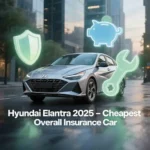
The Elantra is eligible for lower premiums because:
- Typical driver assistance technology
- Insurance records with low claim frequency
- Lower repair costs
- Minimal risk of theft
Cars with typical accident results are preferred by insurers, and the Elantra usually fits into that category.
Important Elements That Lower the Cost of Insurance for These Vehicles
There are a number of similarities between Toyota and other brands of vehicles that affect the cost of insurance. Drivers can choose vehicles that naturally fit into lesser premium categories by being aware of these factors.
Low levels of Theft
Insurance risk is decreased for vehicles with reduced theft rates. Theft frequency is below average for many Toyota vehicles, particularly the Prius and Yaris.
Moderate Engine capacity
Moderately powered vehicles are thought to be less likely to encourage careless driving. Additionally, they are less expensive to fix, which lowers insurance quotes even more.
Advanced Driver Assistance Systems
Modern automobiles are loaded with technologies like:
- Warning of lane departure
- Alert for forward collisions
- Speed control that modifies
By decreasing the frequency of accidents, these solutions eventually result in cheaper insurance costs.
How Driving Practices Affect Insurance Prices
Drivers significantly influence the cost of insurance. Behavior is just as important to insurance companies as car type. Among the factors that are affecting premiums are:
- Annual mileage
- The frequency of previous claims
- Driving background
- Location and normal traffic patterns
- Long-term insurance advantages are affected by consistent, safe driving.
Many drivers assess the 2025 Toyota Camry insurance cost in comparison to other affordable alternatives.
How to Reduce Your Auto Insurance Additionally
Drivers can lower their insurance premiums by taking sensible actions, even if they drive a cheap car.
Raise Deducted expenses
Monthly rates are reduced when deductible amounts are raised. In the event of an accident, it transfers some financial liability to the driver..
Combine Your Policies
When drivers combine auto insurance with renters’ or homeowners’ coverage, several insurance companies lower their rates.
Maintain a Clean Driving Record
Insurance companies view a driver with a spotless driving record as responsible and less likely to cause expensive collisions.
Outside Factors Influencing Insurance Prices
Insurance premiums may increase or decrease in response to outside factors unrelated to the driver, such as:
- Local accident rates
- Costs of market repairs
- Changes in the economy
- Environmental trends that raise the frequency of claims
Drivers are better able to predict long-term changes when they are aware of these issues.
Common Insurance Terms Explained
Premium: The sum of money paid for insurance.
Deductible: The amount the driver must pay before insurance starts is known as the deductible.
Liability coverage: defense against claims for property damage and bodily harm.
Collision coverage: Protects your car in the event of an accident.
Complete Coverage: Includes non-collision incidents, such as storms and theft.
For detailed definitions, the Insurance Information Institute provides a helpful resource:
https://www.iii.org
FAQs
What is the least expensive Toyota model to insure?
Because of their small size and reasonable repair costs, the Toyota Yaris and Toyota Corolla typically have the lowest insurance rates.
How does hybrid technology impact insurance?
Indeed. Low claim intensity is seen in models like the Toyota Prius, which rarely lowers premiums.
Is insurance for smaller engines always less expensive?
Yes, most of the time. A lower performance risk category is associated with smaller engines.
Why do safety ratings have such a significant influence on insurance?
High-rated cars lessen insurer risk by reducing catastrophic injury claims.
Is insurance for Toyota SUVs costly?
Not all the time. One of the less expensive SUVs to insure is frequently the Toyota RAV4.
Conclusion
Strong safety performance, reasonable repair costs, and fewer claims are common traits of cars with low insurance rates. Many cars easily fit into affordable insurance categories. This includes popular Toyota models like the Corolla, Camry, or RAV4, as well as other options like the Mazda 3 or Hyundai Elantra. Knowing about vehicle design, safety technology, and market trends helps you make smart choices that fit your budget. The key is to choose a car that balances daily driving needs, long-term value, and convenience.
2 thoughts on “Cars with Cheap Insurance: Top 10 Budget-Friendly”